
Not all LED lights are dimmable. A lamp, strip, module, or luminaire must be specifically designed to operate with a dimming system.
Even when an LED product is marked as dimmable, it may not work correctly with every dimmer. The LED, driver, control method, electrical load, and wiring must be compatible.
Signify’s technical guidance states that only LED lamps specifically designed by the manufacturer as dimmable should be dimmed. Using a non-dimmable LED or an incompatible control method can result in poor behavior or complete failure.
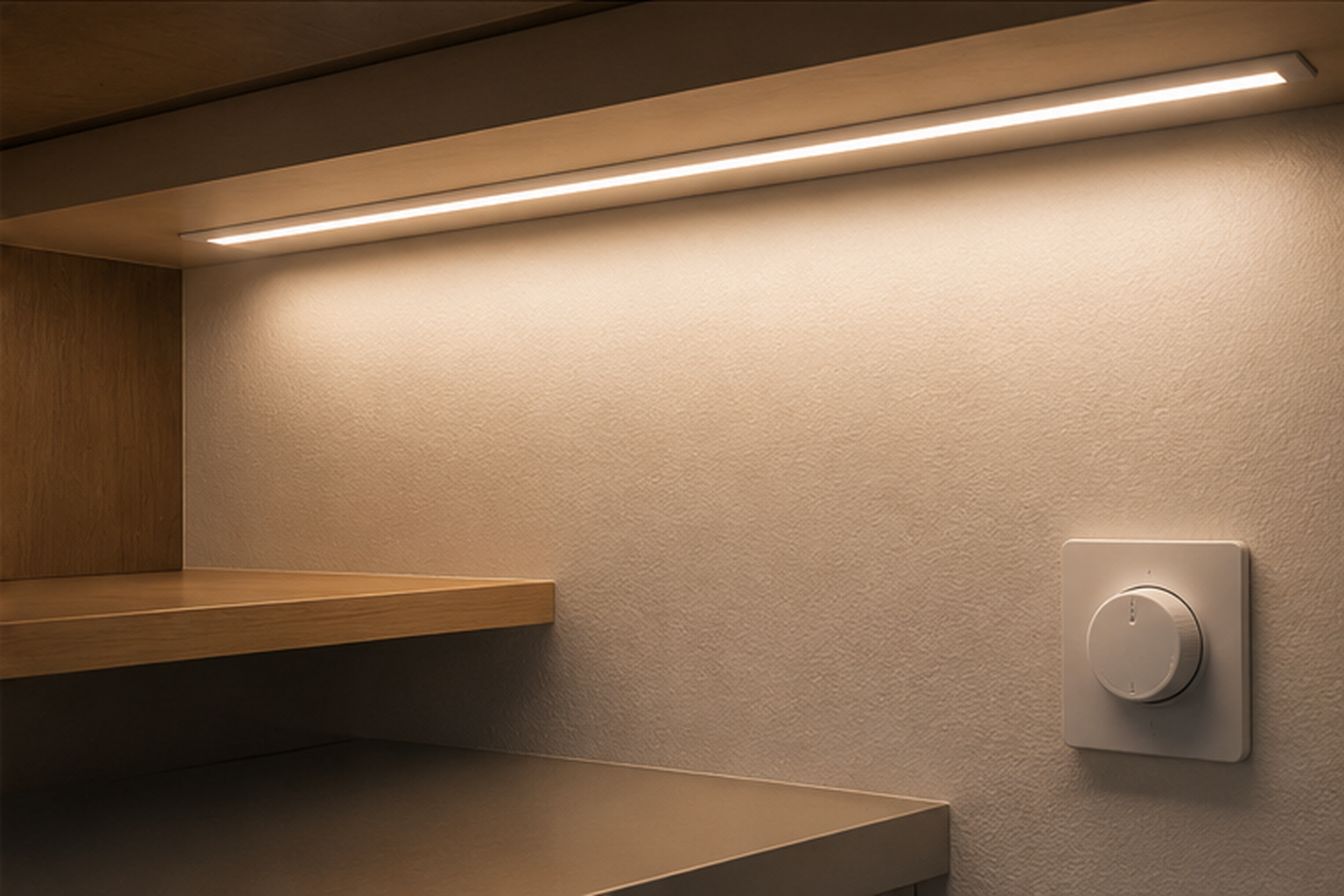
LED chips operate through electronic drivers rather than directly in the same way as traditional incandescent filaments.
The driver must be able to interpret the dimming signal and reduce the LED output in a controlled manner.
The lamp, strip, or luminaire should be clearly identified as dimmable.
A standard non-dimmable LED product should not be connected to a dimmer simply because it uses less power.
For low-voltage LED strips, the power supply or driver must support the intended dimming method.
A non-dimmable constant-voltage power supply may continue to deliver full output or behave unpredictably when connected to an unsuitable wall dimmer.
The dimmer must be designed for the LED load and compatible with the driver.
Compatibility documents from lighting manufacturers often list specific lamp-and-dimmer combinations because performance can vary between models.
Different projects use different control systems. The method should be confirmed before purchasing the driver or LED lighting.
Leading-edge and trailing-edge wall dimmers adjust the AC input waveform.
The LED lamp or driver must support the specific phase-cut method. An old dimmer originally designed for high-wattage incandescent lamps may not work properly with a small LED load.
This method is common in commercial lighting. Separate low-voltage control wires send the dimming signal to a compatible driver.
The driver, controller, and wiring design must all support 0–10 V operation.
DALI is a digital lighting-control method often used in larger commercial and architectural projects.
It can support individual addressing, grouping, scenes, and building-control integration when all components are correctly specified.
Many constant-voltage LED strips use pulse-width modulation through a compatible controller.
Single-color, tunable-white, RGB, RGBW, and addressable strips require different controllers and wiring arrangements.
An incompatible dimmer does not always produce a complete loss of light. It may create several smaller performance problems.
The LEDs may flicker at certain brightness levels or when the dimmer approaches its minimum setting.
Flicker can also result from unstable power, poor wiring, an overloaded driver, or an unsuitable controller.
Some LEDs may dim smoothly from full output to a moderate level but switch off before reaching very low brightness.
The usable range depends on the lamp, driver, dimmer, minimum electrical load, and system design.
The light may remain off as the dimmer is raised and then suddenly switch on at a higher level. It may also turn off abruptly when dimmed downward.
Manufacturers’ compatibility testing commonly evaluates issues such as flicker, pop-on, low-end performance, and the number of lamps connected to the dimmer.
Buzzing, pulsing, uneven brightness, or delayed starting can indicate an incompatible combination.
Continuing to operate a poorly matched system may also affect user comfort and component reliability.
The aluminum profile does not control electrical dimming. Dimmability comes from the LED strip, power supply, driver, controller, and dimmer.
However, led aluminum channel Profiles still affect the quality of the finished dimmable lighting installation.
A diffuser helps blend the light from individual LEDs. This is useful at low brightness levels, where visible LED points may otherwise become more noticeable.
The profile depth, diffuser opacity, and LED density influence how continuous the light appears.
Aluminum can help move heat away from the strip when the LED tape is mounted correctly.
Stable operating temperature supports more consistent LED and driver performance, although the complete thermal design must remain within the product specifications.
Profiles provide a defined space for the LED strip and can help guide cable entry, end caps, connectors, and mounting positions.
For recessed, corner, pendant, cabinet, or wall installations, selecting the correct channel shape helps achieve a cleaner finish.
Begin with the required lighting effect rather than selecting each component separately.
Confirm the LED strip voltage, wattage per meter, total run length, color type, dimming method, driver capacity, controller loading, and cable route.
The internal width of the profile must match the LED strip. The channel length should also allow space for end caps, wiring, connectors, and corners.
For long runs, the installer should calculate power demand and voltage drop. Several shorter powered sections may perform more consistently than one long strip supplied from only one end.
Our factory supplies LED Aluminum Channel Profiles for surface-mounted, recessed, corner, suspended, cabinet, stair, wall, and architectural lighting.
Buyers can request different profile dimensions, lengths, surface finishes, diffuser types, end caps, mounting clips, suspension components, and packaging methods.
Before bulk ordering, we recommend testing the selected strip inside the profile with the actual diffuser and dimming system. This helps confirm the fit, light uniformity, brightness range, heat behavior, and final appearance.
Check that the LED product is marked dimmable, identify the supported control method, review the driver specification, and use a dimmer recommended for the expected electrical load.
When possible, test a complete sample circuit before installation across the full project. A successful test with one lamp does not always confirm performance when many lamps or long LED-strip runs are connected.
Planning dimmable cabinet lighting, ceiling lines, retail displays, wall features, or commercial linear lighting? Send us the LED strip width, profile type, required length, diffuser preference, quantity, and project drawing. We will recommend suitable LED aluminum channel profiles and prepare a customized quotation.