The better question is whether the manufacturer can provide the correct light output, glare control, driver system, dimensions, testing information, and supply support for the intended installation.
LED troffers are commonly available in ceiling-compatible formats such as 1 × 4 ft, 2 × 2 ft, and 2 × 4 ft. They may be supplied as complete LED luminaires or used as part of an approved retrofit solution for existing fluorescent fixtures.
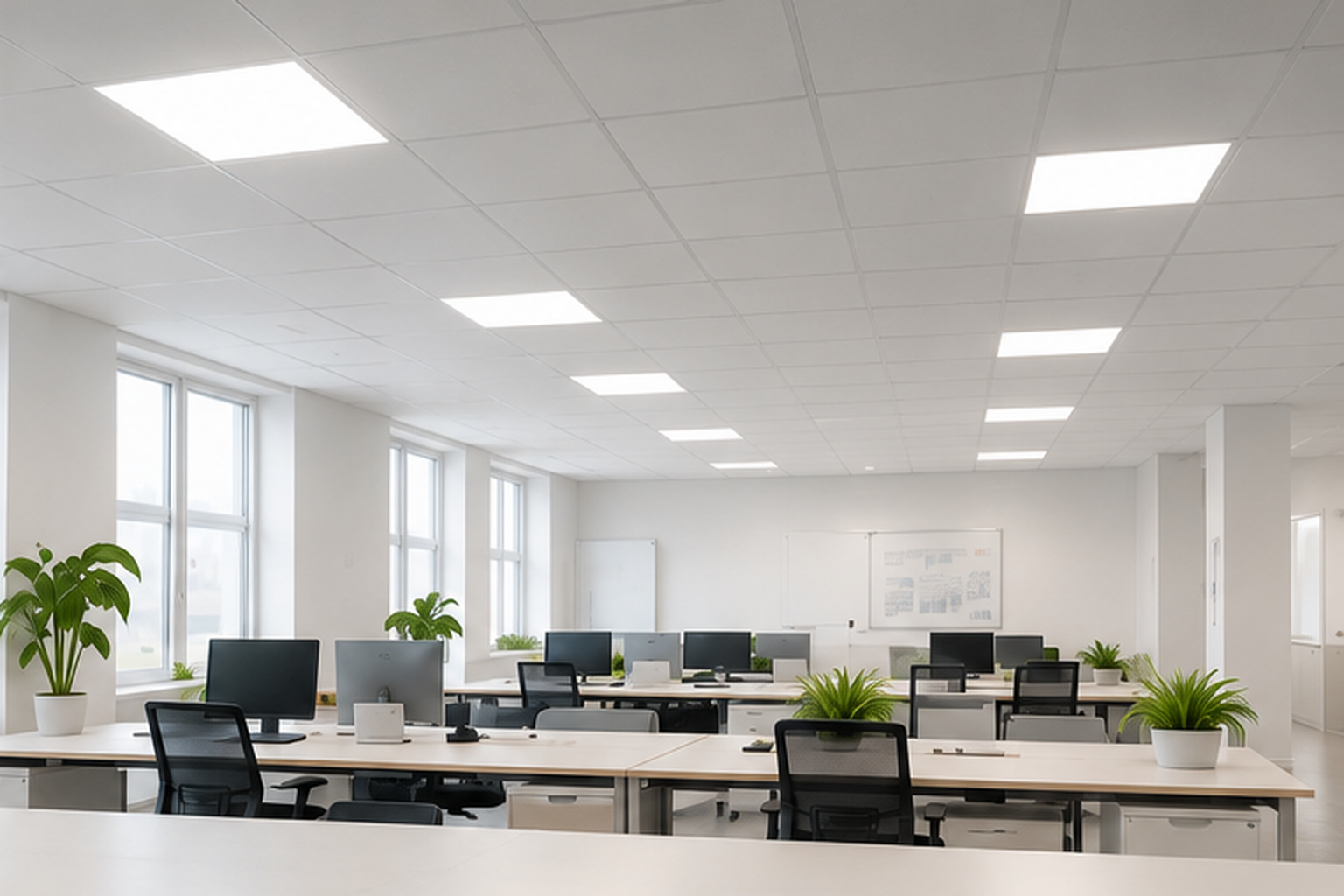
A troffer should be evaluated as a complete luminaire rather than judged only by wattage or appearance.
The required lumen output depends on the room size, ceiling height, fixture spacing, surface reflectance, and visual tasks performed below the light.
More lumens are not always better. Excessive output can create discomfort, while insufficient output may leave work areas unevenly illuminated.
A quality optical system should distribute light without creating uncomfortable brightness in the normal viewing direction.
Diffusers, lenses, reflectors, internal spacing, and LED positioning all affect the appearance of the illuminated surface. The U.S. Department of Energy has noted that troffer designs can differ substantially in luminance patterns and perceived glare.
Color temperature should be selected according to the application and maintained consistently across the project.
Buyers should also review color-rendering requirements and permissible color variation, especially when hundreds of fixtures will be installed in the same building.
The driver controls the power supplied to the LED modules. It directly affects starting performance, dimming behavior, flicker, electrical compatibility, and long-term operation.
The driver output must match the voltage and current requirements of the LED system.
An unsuitable driver may cause unstable output, premature failure, overheating, or inconsistent brightness between fixtures.
Commercial projects may require 0–10 V, DALI, phase-cut, sensor-based, or other control systems.
The required control method should be confirmed before ordering. Adding dimming after the fixtures have already been manufactured may require replacement drivers or other electrical changes.
Some projects require emergency battery packs, occupancy sensors, daylight control, or centralized building management.
These options affect the internal space, wiring, testing, certification, and final cost of the luminaire.
A dependable troffer should have a stable housing, secure electrical connections, suitable thermal design, and an optical system that can be assembled consistently.
The frame should remain square during transportation and installation. Poor alignment can create visible gaps in suspended ceilings or make diffuser installation difficult.
Surface coating, corner joints, mounting points, and packaging all influence the appearance of the installed product.
LED modules and drivers generate heat during operation. The housing must allow heat to be transferred and controlled within the limits of the electrical components.
Aluminum components are often used because they combine relatively low weight with practical forming and heat-transfer properties.
The diffuser should fit securely without visible distortion. Its material and optical texture affect light transmission, glare, and LED-dot visibility.
The manufacturer should confirm whether the diffuser is intended for office, education, retail, or other specific lighting environments.
Troffers and linear LED profiles are different product formats, but many lighting projects use both.
An office may use troffers for general illumination and aluminum-profile lighting for shelves, corridors, reception desks, coves, wall features, or meeting-room details.
Using compatible color temperatures across both systems creates a more coordinated result.
An LED Strip Light Aluminum Profile may also be used in custom linear luminaires, perimeter lighting, or modular ceiling systems.
The profile shape, diffuser, LED-strip width, driver position, and installation method should be planned as one complete system.
Surface-mounted profiles are useful for finished ceilings and furniture. Recessed profiles create a more integrated appearance, while suspended profiles can provide visible architectural lines.
The selected profile must provide adequate internal width for the strip and enough space for the intended wiring arrangement.
Do not compare suppliers by unit price alone. Request technical documents and evaluate the complete project offer.
Buyers should review photometric information, power consumption, efficacy, color temperature, color rendering, driver brand or specification, dimming method, operating voltage, fixture dimensions, installation type, warranty terms, and packaging.
For retrofit projects, the existing ceiling grid, wiring, emergency system, and control system should be inspected before products are selected. The Department of Energy identifies several different LED troffer retrofit approaches, each with different installation and compatibility considerations.
Our factory supports LED aluminum profiles and related accessories for commercial, office, school, retail, and architectural lighting projects.
Buyers can submit drawings or samples for profile selection, customized length, diffuser matching, surface finishing, mounting accessories, end caps, and packaging requirements.
Sample confirmation is recommended before bulk production. It allows the buyer to check the fit of the LED strip, appearance of the diffuser, profile dimensions, installation method, and final lighting effect.
The best LED troffer supplier is the one that can match the actual lighting specification and provide consistent products across the complete order.
For projects combining ceiling troffers with linear decorative or task lighting, the aluminum profile supplier should also understand strip dimensions, diffusers, installation structures, and project packaging.
Need aluminum profiles to complement an office troffer, linear-lighting, or commercial ceiling project? Share your drawings, LED strip width, installation type, profile length, diffuser requirement, and order quantity. Our team will prepare an LED Strip Light Aluminum Profile proposal based on your application.