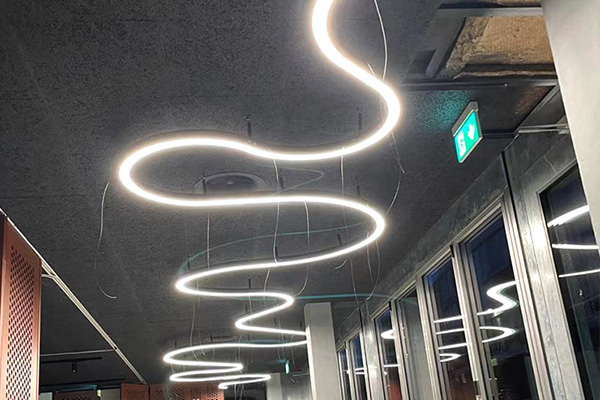
Dubai mega projects move at scale. Whether it is a luxury retail complex, a high-rise residential tower, a mixed-use development, or a hospitality landmark, lighting design plays a defining architectural role. Continuous linear lighting, recessed ceiling lines, façade accents, and feature walls all depend on precision-engineered LED aluminum profiles. In these projects, the profile is not just a mounting accessory. It is a structural, thermal, and visual component that directly affects performance and finish quality.
If you are a Dubai-based procurement manager, contractor, or lighting integrator, sourcing custom LED aluminum profiles requires more than comparing prices. It requires risk control, engineering alignment, production stability, and reliable delivery planning. This guide explains how to source correctly and how to work with a manufacturer capable of supporting large-scale developments.
Dubai mega projects typically involve:
Long continuous lighting runs
Tight installation tolerances
High ambient temperatures
Premium architectural finishes
Multi-phase delivery schedules
Before sending RFQs, define the actual installation scenario. Is the profile recessed in gypsum ceilings, embedded in stone panels, mounted in aluminum façade frames, or integrated into joinery? What is the groove width? What is the maximum continuous run length? What LED strip power will be used?
Without this clarity, suppliers may offer standard catalog channels that do not match real construction details. Rework at site level becomes expensive, especially when ceiling closures and façade sealing are already completed.
A professional sourcing process begins with dimensional drawings, strip specifications, diffuser expectations, and surface finish requirements.
Dubai developments often require non-standard sections. Narrow grooves, slim visual lines, or deep-profile architectural coves may not match standard stock extrusions. In such cases, a custom LED aluminum profile is not a luxury; it is a necessity.
When evaluating manufacturers, ask:
Do they control extrusion in-house?
Can they modify wall thickness and chamber geometry?
Do they support CNC machining for wire exits and connectors?
Can they manage anodizing or powder coating internally?
A supplier that only resells profiles cannot quickly adjust geometry to meet site conditions. A manufacturer with full extrusion and surface treatment control can adapt cross-sections, improve structural stiffness, and coordinate finish consistency across batches.
For Dubai projects where lighting lines span thousands of meters, this flexibility significantly reduces technical risk.
The visual success of linear lighting depends on profile depth, internal width, and diffuser pairing. Dot visibility, glare control, and brightness consistency are determined by the relationship between LED chip spacing and diffuser distance.
Shallow channels may produce visible hotspots. Deep channels improve light blending but must still fit construction constraints. Internal width must allow full strip adhesion to prevent peeling under high temperature conditions common in Gulf climates.
A well-designed aluminum profile distributes heat evenly and maintains stable strip performance during long operating hours. Thermal management is particularly important in Dubai retail and hospitality environments where lighting often operates continuously.
Choosing a durable LED aluminum profile means selecting one engineered for both structural integrity and heat dissipation, not simply one that looks slim in section drawings.
Dubai environments combine high heat, humidity variations, and heavy cleaning cycles in commercial spaces. Surface treatment is not only aesthetic; it affects corrosion resistance and long-term appearance.
Anodized finishes offer hardness and metallic texture. Powder coating allows color matching with interior schemes. However, coating thickness must be controlled to ensure diffusers and end caps fit precisely.
When sourcing, confirm that surface treatment is part of the manufacturer’s integrated production process. Batch consistency matters in phased projects where deliveries occur months apart. Shade variation across towers or floors can compromise architectural uniformity.
Clear documentation reduces disputes and delays. A structured RFQ should include:
| Specification Item | Why It Matters |
|---|---|
| Profile cross-section drawing | Prevents mismatch with site grooves |
| LED strip width and wattage | Ensures correct inner width and heat planning |
| Diffuser type and light appearance target | Controls glare and dot visibility |
| Surface finish standard | Maintains visual consistency |
| Required accessories | Avoids on-site improvisation |
| Tolerance expectation | Supports alignment across long runs |
| Delivery schedule | Aligns with construction phases |
Providing these details upfront allows manufacturers to propose accurate solutions rather than generic alternatives.
For mega developments, a single profile sample is insufficient. Instead, conduct a full lighting mockup including:
Profile
Diffuser
LED strip
Power supply
Actual mounting substrate
Mockups reveal joint alignment, glare behavior, brightness consistency, and installation practicality. Long-run mockups are especially important, as small deviations accumulate over distance.
This step protects both procurement teams and manufacturers by confirming performance before large-scale production begins.
Dubai projects often require phased delivery across multiple buildings or zones. Delays in profile supply can halt ceiling closures and interior finishing work.
When selecting a partner, confirm:
Monthly extrusion capacity
Ageing and straightening capability
Surface treatment throughput
Packaging standards for long lengths
Experience in export logistics to the UAE
Reliable delivery planning is part of the sourcing decision. Profiles must arrive protected against bending and surface damage, especially when lengths exceed standard container dimensions.
Large-scale developments require more than product supply. They require coordination. Engineering discussions, sampling feedback, drawing confirmation, tolerance control, and phased production planning must align.
KOGEE manufactures architectural and LED aluminum profiles with integrated extrusion, surface treatment, and deep processing capabilities. This structure supports consistent quality, section customization, and stable batch production for international projects.
If you are comparing profile structures, diffuser combinations, or exploring custom solutions for a Dubai mega project, you can review available options on our LED Aluminium Profiles page to understand structural possibilities before discussing detailed specifications with our engineering team.
Sourcing custom LED aluminum profiles for Dubai mega projects is a strategic engineering decision. The right supplier must deliver accurate extrusion geometry, stable surface finishing, reliable thermal performance, and phased production capacity. Clear RFQ documentation, realistic mockups, and structured quality control reduce risk and protect project timelines.
If your Dubai development requires custom profile sections, precise tolerances, or large-volume phased delivery, our team can support you from cross-section confirmation to production planning and shipment coordination. Share your drawings, strip specifications, and project schedule with us, and we will help you develop a practical aluminum profile solution aligned with your construction requirements.